
The Complete Local SEO Checklist: 10 Ways to Rank on Google Maps
Executing a structured local SEO checklist is the most reliable way for regional enterprises, brick-and-mortar storefronts, and service-area providers to capture high-intent local buyers. When consumers search for urgent services within their immediate geographic vicinity, they rarely scroll past the top three map listings.
Securing your position within Google’s Local 3-Pack requires more than setting up a basic business profile and waiting for calls. Search algorithms evaluate geographic proximity, brand prominence, category relevance, user reviews, and technical website signals simultaneously. Without a systematic local SEO checklist, critical ranking signals fall through the cracks, allowing regional competitors to capture your local market share.
In this exhaustive, 3000+ word execution guide, we provide a proven local SEO checklist engineered for modern search algorithms. Whether you manage a single retail outlet or oversee multi-location regional service franchises, this blueprint provides step-by-step optimization strategies to dominate map packs and drive qualified phone calls, foot traffic, and consultation requests via adverola.com.

Why Every Growing Business Needs a Dedicated Local SEO Checklist
Local search queries carry immediate commercial intent. Over 75% of consumers who run a localized search on mobile devices visit a related physical business within 24 hours. If your company remains invisible on map packs, you surrender qualified customers directly to competing brands located on the same block.
Local Discovery Funnel:

[ High-Intent Local Query: "plumber near me" / "marketing agency nearby" ]
                            │
                            ▼
      [ Google Local 3-Pack (Map Snaketrail) ] ──► 70%+ Direct Clicks
                            │
                            ▼
      [ Traditional Organic Desktop/Mobile Results ] ──► 30% Shared Clicks
Implementing this local SEO checklist systematically protects your digital footprint. By aligning foundational directories, on-page location silos, structured schema tags, and proactive customer review collection, your business builds lasting regional prominence that withstands algorithm shifts.
Core Pillars of Google Local Search Ranking Algorithms
Google relies on three primary core evaluation pillars to calculate local search rankings:
Google Local Search Evaluation Engine:

1. Relevance   ──► How closely your profile & content match user search intent
2. Distance    ──► Physical proximity between user location and your verified address
3. Prominence  ──► Domain authority, review velocity, backlinks, and brand reputation
A comprehensive local SEO checklist balances all three signals. While you cannot manipulate a customer’s physical distance from your storefront, you exercise absolute control over your relevance through category mapping and your prominence through structured authority campaigns across adverola.com.
Phase 1: Google Business Profile (GBP) Optimization Blueprint
Your Google Business Profile serves as the direct anchor of any effective local SEO checklist. Incomplete or inconsistent profile fields suppress your local visibility.
Completing every profile field transforms your basic map presence into a key asset within this local SEO checklist.
Google Business Profile Hierarchy:

[ Primary Core Category ] ──► Maximum Ranking Weight (65%+)
          │
          ├──► [ Secondary Categories ] (Expand related service reach)
          │
          ├──► [ Complete NAP Consistency ] (Exact match to local records)
          │
          └──► [ High-Resolution Geotagged Media & Active Weekly Updates ]
1. Primary and Secondary Category Selection
Selecting the correct primary category carries immense weight in local algorithm calculations. If you run a commercial plumbing enterprise, setting your primary category to “Plumber” rather than “Contractor” provides immediate relevance alignment. Use secondary category slots to capture adjacent service lines without diluting your primary commercial focus.
2. Precise Business Name Guidelines
Adhere strictly to official guidelines. Never stuff artificial keywords, zip codes, or promotional taglines into your registered Google Business Profile name unless they form your legally registered entity name. Google’s spam detection algorithms actively suspend profiles exhibiting aggressive keyword manipulation.
3. Comprehensive Business Description
Draft a comprehensive, 750-character business summary. Front-load your primary service offerings, geographic operating zones, and commercial value propositions within the first 250 characters. Maintain natural language flow and integrate related regional terms cleanly.
4. Products and Services Catalog Configuration
Populate every individual service module inside your GBP dashboard. Provide comprehensive pricing brackets, detailed service descriptions, and direct URL endpoints pointing back to specific service landing pages on your website.
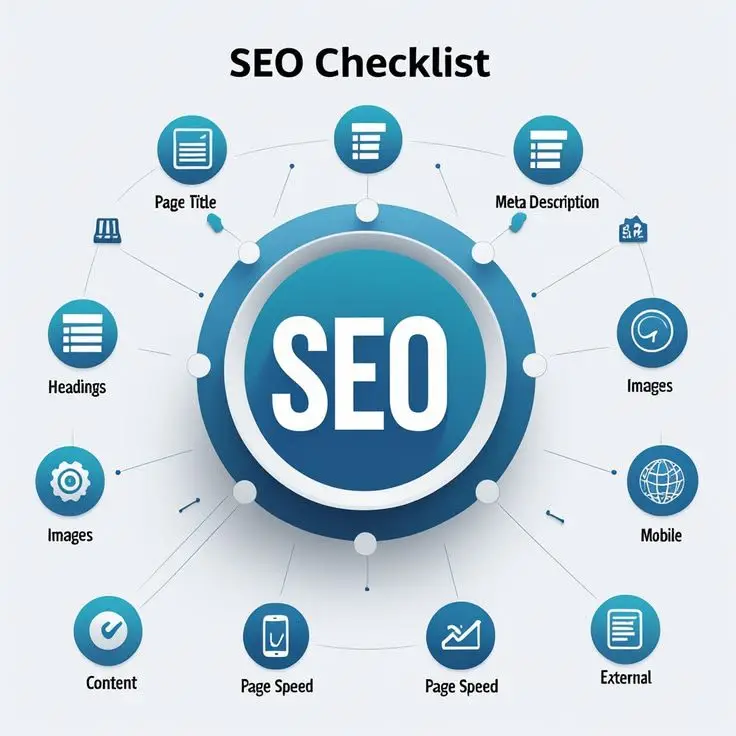
Phase 2: On-Page Local SEO and Website Architecture
A complete local SEO checklist demands tight integration between your Google Business Profile and your self-hosted website infrastructure.
Structuring your website with clear location hubs reinforces every objective outlined in this local SEO checklist.
Location Silo URL Architecture:

[ Domain Homepage ]
         │
         ├──► [ Locations Hub: /locations/ ]
         │            │
         │            ├──► [ City Page A: /locations/gurugram/ ]
         │            │           │
         │            │           └──► [ Local Schema + Geotargeted Testimonials ]
         │            │
         │            └──► [ City Page B: /locations/noida/ ]
         │
         └──► [ Primary Services Hub: /services/ ]
5. Dedicated Geo-Targeted Location Pages
If your enterprise serves multiple distinct municipalities, avoid packing all service areas onto a single generic contact page. Build dedicated location pages for each target city. Each individual location page must feature:
- Unique, non-duplicated service descriptions customized to that regional market.
- Embedded Google Maps iframe pointing to your verified business listing.
- Localized client testimonials, customer case studies, and photographic project proof.
- Regionally relevant driving directions referencing notable local landmarks and transport arteries.
6. Strict NAP Consistency Across Footers and Headers
Ensure your Name, Address, and Phone number (NAP) appear identically across every page of your digital footprint. Display your physical address and regional phone number within your site footer wrapped in clean HTML rather than flat image graphics so search spiders can easily parse your location data.
7. Geo-Targeted Meta Tags and Heading Hierarchies
Optimize your page titles, meta descriptions, and heading tags (H1, H2, H3) to reflect geographic search queries. A proven meta title structure follows this pattern:
Primary Service in City, State | Recognized Brand Name
Ensure your H1 header reinforces this localized intent while subsequent H2 sections expand on sub-services and local project workflows.
Phase 3: Structured Data and Local Business Schema Markup
Search engines rely on structured JSON-LD code to interpret company metadata without ambiguity. Integrating structured schema remains an essential step in this local SEO checklist.
JSON
{
  "@context": "https://schema.org",
  "@type": "LocalBusiness",
  "name": "Adverola Digital Solutions",
  "image": "https://adverola.com/assets/logo.png",
  "@id": "https://adverola.com/#localbusiness",
  "url": "https://adverola.com",
  "telephone": "+91-XXXXXXXXXX",
  "address": {
    "@type": "PostalAddress",
    "streetAddress": "Cyber City Phase 2",
    "addressLocality": "Gurugram",
    "addressRegion": "Haryana",
    "postalCode": "122002",
    "addressCountry": "IN"
  },
  "geo": {
    "@type": "GeoCoordinates",
    "latitude": 28.4595,
    "longitude": 77.0266
  },
  "openingHoursSpecification": {
    "@type": "OpeningHoursSpecification",
    "dayOfWeek": [
      "Monday",
      "Tuesday",
      "Wednesday",
      "Thursday",
      "Friday"
    ],
    "opens": "09:00",
    "closes": "18:00"
  }
}
Verify your schema implementation against official standards using the Google Search Central Local Business documentation. Eliminating syntax errors ensures search engines map your physical coordinates, operational hours, and service radiuses accurately.
Phase 4: Local Citation Building and Directory Synchronization
A foundational task on your local SEO checklist is establishing identical citations across primary web directories and business portals.
Cleaning duplicate citations across web directories is a non-negotiable requirement of any technical local SEO checklist.
Citation Distribution Ecosystem:

                    [ Core Tier 1 Aggregators ]
                    (Data Axle, Neustar, Foursquare)
                                  │
                                  ▼
      [ Tier 2 Directories ] ───────────► [ Niche-Specific Portals ]
      (Yelp, YellowPages, Bing)           (Clutch, Houzz, Avvo, TripAdvisor)
8. Primary Data Aggregators
Global map platforms often draw raw location records directly from major data aggregators like Data Axle, Foursquare, and Neustar Localeze. Submitting verified corporate records to these top-level aggregators ensures your location records propagate automatically across hundreds of secondary downstream navigation networks.
9. Auditing and Cleaning Duplicate Listings
Inconsistent citations—such as an outdated suite number, a legacy telephone area code, or duplicate profiles created by past staff—dilute your prominence signals. Run quarterly citation audits to detect, merge, and prune outdated duplicate records.
Phase 5: Customer Review Acquisition and Sentiment Velocity
Customer reviews influence both search algorithms and human buying decisions. Maintaining an active review generation strategy is a cornerstone of this local SEO checklist.
Earning consistent customer reviews accelerates your map ranking momentum across this entire local SEO checklist.
Review Acceleration Strategy:

[ Service Delivery Complete ]
             │
             ▼
[ Automated SMS / Email Prompt ] ──► Direct Shortlink to GBP Review Modal
             │
             ▼
[ Customer Submits Review with Service Keywords ]
             │
             ▼
[ Owner Response Within 24-48 Hours Reinforcing Local Relevance ]
Review Optimization Tactics
- Integrate Natural Keywords: Encourage satisfied clients to mention the specific service performed and their neighborhood location in their reviews. A review stating “Adverola provided outstanding local SEO services in Gurugram” carries significantly more algorithmic weight than a generic “Great job!”
- Maintain Consistent Review Velocity: Avoid collecting 50 reviews in three days followed by four months of inactivity. Algorithms favor a steady, predictable stream of customer feedback over time.
- Respond to All Feedback: Formulate thoughtful, professional responses to both positive and negative reviews within 48 hours. Use owner responses to reinforce your commitment to customer satisfaction and subtly mention relevant service terms.
Phase 6: Local Link Acquisition and Regional PR
Standard backlink campaigns often focus on high-authority global blogs. However, an effective local SEO checklist prioritizes geographically relevant backlinks from community sources.
Local Link Generation Matrix:

├── Regional Chamber of Commerce Memberships
├── Local Sports Team & Community Event Sponsorships
├── Coverage in City Business Journals & Neighborhood News
└── Strategic Partnerships with Non-Competing Regional Vendors
A backlink from a local chamber of commerce, an active neighborhood blog, or a regional business journal sends powerful geographic signals to Googlebot. These local links often outperform generic global backlinks when it comes to boosting rankings within specific zip codes.
Comprehensive Local SEO Checklist: 10-Point Technical Action Table
Use this operational table to audit your current implementation status and identify priority action items across your digital assets:
| Audit Phase | Critical Action Item | Expected Technical Output | Priority Level |
| GBP Core | Primary Category Calibration | Explicit match with highest-volume commercial query | Critical (P0) |
| GBP Core | NAP Integrity Audit | 100% exact match across profile, website, and legal docs | Critical (P0) |
| Website | Dedicated Location Silo Pages | Unique URLs for each serviced municipality | High (P1) |
| Website | Responsive Local Page Speed | LCP under 2.5s and mobile-first layout rendering | High (P1) |
| Schema | JSON-LD LocalBusiness Integration | Geocoordinates, hours, and department tags validated | High (P1) |
| Citations | Tier 1 Data Aggregator Sync | Unified profiles across major map networks | Medium (P2) |
| Citations | Duplicate Listing Cleanup | Removal of legacy records, outdated suites, and numbers | Medium (P2) |
| Reputation | Automated Review Acquisition | Consistent weekly inflow of keyword-rich reviews | High (P1) |
| Reputation | Public Owner Review Responses | Timely professional replies posted within 48 hours | Medium (P2) |
| Authority | Regional Link Building | Contextual backlinks from regional businesses & news | Medium (P2) |
Review this local SEO checklist during monthly operational reviews to keep your regional optimization efforts on track.
Mobile Usability and Voice Search Optimization
Over 60% of regional commercial queries originate via mobile devices or hands-free voice search interfaces such as Google Assistant, Apple Siri, and Amazon Alexa. Incorporating voice search optimization into your local SEO checklist prepares your brand for the way consumers search today.
Voice searches are conversational and typically phrased as complete questions:
- “Where is the closest digital marketing agency open right now?”
- “Who is the highest-rated SEO consultant in my area?”
Voice Search Implementation Strategy
- Build an intuitive FAQ section on every primary location page answering conversational question queries directly.
- Ensure your operational hours remain accurate on your Google Business Profile, especially during public holidays and seasonal shifts.
- Maintain fast mobile page load speeds to prevent prospective customers from bouncing back to search result pages.
Advanced Tracking: How to Monitor Local 3-Pack Rankings
Tracking local search performance requires specialized tools. Standard national ranking dashboards fail to capture the hyper-local variations of map pack results.
Local Geogrid Tracking Model:

    [ 1.0 km ]  ──►  Rank #1 (Direct Storefront Proximity)
    [ 2.5 km ]  ──►  Rank #2 (Strong Category Relevance)
    [ 5.0 km ]  ──►  Rank #3 (Competitive Edge)
    [ 7.5 km ]  ──►  Rank #6 (Proximity Boundary Friction)
Because Google Maps rankings fluctuate depending on where the user is physically standing, use geogrid tracking software to visualize your rankings across neighborhood map pins. Tracking performance across these pins helps you pinpoint the exact intersections and neighborhoods where your profile begins to lose visibility, guiding your local content and citation building efforts on adverola.com.
5 Costly Local SEO Mistakes to Avoid
Avoiding common map suspension triggers keeps your implementation of this local SEO checklist fully protected.
Even experienced teams make avoidable errors that hold back their local search rankings. Avoid these five common pitfalls:
- Using a Virtual Office or P.O. Box: Google actively flags and suspends profiles tied to shared co-working spaces or virtual mailboxes without physical signage or on-site staff.
- Inconsistent Phone Numbers: Using dynamic call-tracking numbers on your Google Business Profile without preserving your original primary number can create data conflicts across web directories.
- Keyword Stuffing in Location Descriptions: Cramming long lists of zip codes and city names into page footers damages readability and triggers search spam penalties.
- Neglecting Profile Updates: An inactive Google Business Profile signals a dormant business. Publish regular weekly updates, new product photos, and holiday hours to demonstrate active operations.
- Ignoring Duplicate Google Business Profiles: Having multiple unverified profiles floating around for the same physical address splits your review volume and confuses ranking algorithms.

Step-by-Step Maintenance Schedule to Keep Your Rankings Strong
To ensure your brand maintains category dominance, organize your local SEO checklist tasks into a manageable recurring maintenance schedule:
Weekly Routine
- Publish one Google Business Profile Update highlighting a recent project, customer success story, or operational announcement.
- Upload two to three high-resolution, geotagged photos of your physical facilities, active team members, or completed client deliverables.
- Respond to all new customer reviews across Google, Yelp, and industry-specific directories.
Monthly Routine
- Review geogrid ranking positions for your primary commercial search terms across your target service radius.
- Publish a comprehensive, localized article or customer case study on adverola.com linking back to your target location hub.
- Audit your Google Search Console performance reports for shifts in local click-through rates and high-intent local query impressions.
Quarterly Routine
- Run a full citation sweep to detect and correct inconsistent NAP information across third-party directories.
- Test all website forms, click-to-call phone buttons, and embedded maps on mobile devices to ensure smooth user experiences.
- Validate your JSON-LD structured schema code to ensure compliance with the latest schema.org releases.
Frequently Asked Questions About Local SEO
To verify schema standards, consult the official Google Search Central Local Business documentation.
How long does it take to rank on Google Maps?
Most businesses see measurable ranking improvements within 60 to 90 days of completing their foundational local SEO checklist. However, highly competitive markets—such as legal services, personal injury, emergency roofing, or commercial finance—often require four to six months of steady review acquisition, link building, and on-page optimization to break into the top three map positions.
Can a service-area business rank on Google Maps without a physical storefront?
Yes. Businesses that travel directly to clients (such as plumbers, electricians, or mobile consulting services) can configure their Google Business Profile as a Service-Area Business (SAB). This setup hides your private residential address while displaying your defined geographic service territory on map listings.
What is the single most important factor for ranking on Google Maps?
While Google relies on a combination of relevance, distance, and prominence signals, choosing the correct primary category on your Google Business Profile carries the greatest individual algorithmic weight. Pairing the right primary category with a steady inflow of keyword-rich customer reviews provides the foundation for local pack dominance.
Do Google Business Profile updates actually help search rankings?
Yes. Regularly publishing updates, answering customer questions in the Q&A section, and uploading fresh media demonstrates that your business is active and engaged. These activity signals encourage Googlebot to crawl and re-evaluate your profile more frequently.
Final Thoughts: Build Long-Term Local Market Dominance
Achieving consistent visibility on Google Maps requires a disciplined, structured approach. When you work through this local SEO checklist methodically, you eliminate the guesswork and build a durable competitive moat around your regional operations.
Focus first on the core fundamentals: claim your verified Google Business Profile, align your primary categories, and resolve citation discrepancies across the web. From there, expand your footprint with dedicated location pages, validated local schema markup, and a proactive review generation system.
Stay committed to this local SEO checklist, refine your local relevance month over month, and secure the search visibility and high-intent customer inquiries your business deserves on adverola.com.